Step 1 of 4 · About calculator

Antidepressant tapering calculator

This calculator is a free science-backed tool designed to help you gradually taper your antidepressant medication while minimizing withdrawal symptoms. The plan is based on a hyperbolic antidepressant tapering model and depends on your specific SSRI/SNRI and current dose.

Built on two scientific models

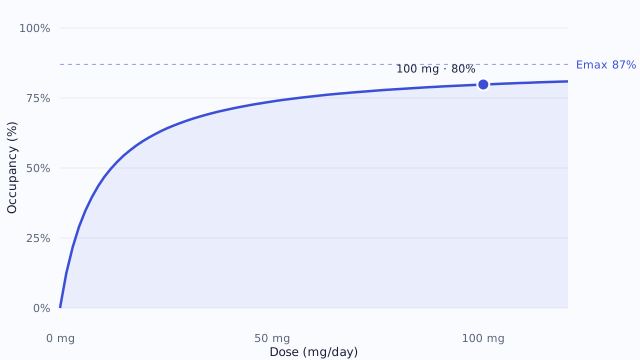
Our tapering calculator is built on two scientific models. The Horowitz–Taylor method (a hyperbolic antidepressant tapering model) determines the tapering schedule. The Hill equation curve model describes the non-linear relationship between dose and serotonin transporter occupancy, used to calculate occupancy at each step.

⚠️ It's not a substitute for medical advice. This calculator can help you visualise a tapering schedule but before making any changes to your medication plan it's necessary to consult a medical professional. Ask a psychiatrist — available after you request your protocol.

How it works

Your personalised taper protocol in three guided steps: a pre-taper risk quiz to suggest a starting speed, build your parameters (drug, dose, region), then view your protocol — preview a few steps and receive the full schedule by email (HTML + PDF). Always review every dose change with your prescriber.

  1. Pre-taper risk check — six evidence-based factors suggest preset A, B, or C.
  2. Build — enter your current dose, region, and speed; generate your protocol.
  3. Your protocol — occupancy chart, step preview, email delivery, and support options.

Key facts about hyperbolic antidepressant tapering

The calculator algorithm is based on peer-reviewed research and has been reviewed by our medical advisors to ensure the accuracy of the tapering model.

  • 72%

    discontinued their antidepressant using hyperbolic tapering strips in a real-world study

    71% of the same people had previously tried to stop at least once and been unsuccessful; the study did not record which method those earlier attempts used. Figures come from tapering-strip research and may not generalise to every taper.

    Source: Groot et al., Therapeutic Advances in Psychopharmacology 2021

  • 56 days

    median taper length in that tapering-strip study — not a target; many people taper over 6–12 months or longer

    This median reflects tapering-strip use in one study. Your timeline depends on how long you have taken the medication, your withdrawal symptoms, and previous attempts — slower is often safer.

    Source: Groot et al., Therapeutic Advances in Psychopharmacology 2021

  • 10%

    serotonin transporter occupancy per tapering step

    This linear reduction prevents withdrawal. Slower, more gradual tapering over several months has shown greater success in reducing withdrawal symptoms than short tapers.

    Source: Horowitz et al., The Lancet Psychiatry 2019

Why hyperbolic tapering?

A hyperbolic tapering model (the Horowitz–Taylor method) shows how the effect of antidepressants in your brain changes depending on dosage. At standard doses, SERT occupancy is around 70–80%, meaning the majority of serotonin transporters are blocked. At these levels, slightly cutting the dose has no major impact on the brain. However, at low doses, even a very small reduction of 1–2 mg can cause a disproportionately large drop in occupancy and lead to significant withdrawal symptoms. That's why those last few milligrams are always the most challenging. Hyperbolic tapering corrects this by reducing the dose gradually and proportionally, keeping the biological impact consistent at each step (Sørensen et al., Molecular Psychiatry 2021).

This isn't just a theory. A study of 1,240 patients taking antidepressants found that 72% of them successfully quit using a hyperbolic model. Most participants had tried other tapering methods previously but were unsuccessful (Groot et al., Therapeutic Advances in Psychopharmacology 2021). By comparison, a large systematic review of linear tapering methods shows that 31% of patients experienced at least one withdrawal symptom after stopping an antidepressant, and 2.8% struggled with severe symptoms even with careful dose reduction (Henssler et al., The Lancet Psychiatry 2024). In simple terms, hyperbolic tapering follows your brain's chemical processes: instead of cutting the same amount each time, you cut smaller amounts as you go. This makes withdrawal relatively predictable. Primary references: Horowitz & Taylor, Lancet Psychiatry (2019) doi:10.1016/S2215-0366(19)30032-X; Horowitz & Taylor, Maudsley Deprescribing Guidelines (Wiley, 2024).

The Hill equation

This equation, also called the Michaelis–Menten or Emax model, illustrates that serotonin transporter occupancy follows a hyperbolic curve (Reeve et al., Journal of Biopharmaceutical Statistics 2013; Preskorn, Journal of Psychiatric Practice 2012).

O(d) = Emax × d / (d + Kd)
  • d — total daily dose (mg), steady-state approximation.
  • Kd — dissociation constant: dose at half-maximal occupancy (mg), from PET/SPECT literature.
  • Emax — plateau occupancy (0–1), drug-specific (typically 0.75–0.85 for SSRIs).

Equal-occupancy step algorithm

The calculator uses an equal-occupancy reduction algorithm based on the Hill equation:

  1. Compute occupancy at the current dose using the Hill equation above.
  2. Subtract the target occupancy decrement (e.g. 10%, 5%, or a custom percentage) to get the new target occupancy.
  3. Solve for the dose that yields this new target occupancy by inverting the Hill equation.
  4. Round the calculated dose to the nearest achievable amount from the selected region's available formulation list (tablets, liquid concentrations).
  5. Repeat until the dose reaches the chosen minimum floor dose before complete discontinuation.

Rows in the schedule table highlight when rounding to available formulations causes a larger-than-target occupancy jump (e.g. >12% instead of 10%). This is a sign to hold longer at that dose or consult your prescriber.

Speed presets

  • A — Faster: ~5 percentage-point occupancy drop per step, 1-week minimum holds.
  • B — Moderate: ~2.5 points per step, 2-week holds (default for many drugs).
  • C — Slower: ~1.5 points per step, 4-week holds — default for several short-half-life or higher-withdrawal-reporting drugs (e.g. paroxetine, venlafaxine).

All three presets fall within the per-drug recommendations of the Maudsley Deprescribing Guidelines, the Royal College of Psychiatrists, and the UK NICE NG222 guideline. The pre-taper risk quiz suggests which preset to start with based on your personalised factors. You can override it at any time.

Formulation rounding

Ideal doses are snapped using tablet/capsule strengths, licensed oral liquids (e.g. Rosemont liquids in the UK, Cipramil/Cipralex oral drops in the EU), and either a compounded-liquid option or a standardised hyperbolic taper strip (Regenboog Apotheek, Netherlands) for fine granularity. ER/XR products that must not be split are modelled conservatively. Precise tapering often requires IR tablets, liquids, or compounding, so discuss options with a pharmacist.

For each ideal dose, we select the nearest possible formulation in your chosen region (UK, NL, and others). If an exact match is not available, your tapering plan will note that the step should be discussed with your local pharmacist.

Symptoms-first tapering

If symptoms after a reduction are intolerable, return to the previous stable dose, allow time to settle, then attempt a smaller reduction. Our symptom checker helps decide whether a symptom is commonly reported during withdrawal.

Frequently asked questions

Common questions about antidepressant tapering, hyperbolic schedules, and how to use this calculator with your prescriber.

  • What is a tapering calculator?

    An antidepressant taper calculator creates a tapering schedule based on your current dose and medication type. It uses the hyperbolic method where each step reduces a comparable percentage of the receptor occupation instead of a constant number of drug milligrams. As a result, you will receive a personalized schedule that you can review with your prescriber.

  • Why use an antidepressant tapering calculator?

    It's just convenient to turn complex pharmacological data into a tangible schedule that you can quickly scan through. An antidepressant taper calculator is especially helpful to those who are tapering off their antidepressants gradually to avoid withdrawal — because the last few milligrams provide the greatest change in modelled SERT occupancy. Moreover, this calculator helps you see the steps in advance, prepare the correct split-tablet dosages, or print out a long-term plan to present to your doctor.

  • How does this calculator work?

    It calculates what proportion of your serotonin transporters are occupied at each dosage using the Hill equation curve model (it describes the relationship between the concentration of the drug and the biological response). Then, the calculator suggests a roadmap to gently reduce your dose with minimal withdrawal symptoms and maintain the same occupancy decrease at each step.

  • What is hyperbolic tapering and why is it recommended?

    Hyperbolic tapering means decreasing your antidepressant dose by progressively smaller milligram amounts. This model is considered gentler with less withdrawal symptoms, compared to the linear model, because antidepressants exhibit a hyperbolic dose response relationship. At low doses, even a small milligram decrease can produce significant effects. Hyperbolic tapering is recommended by the Maudsley Deprescribing Guidelines (2024), the UK NICE NG222 guideline (2022), and the Royal College of Psychiatrists.

  • How slowly should antidepressants be reduced?

    While most patients feel comfortable with reducing their dose by 5-10% every 2-4 weeks, they also tend to slow their taper rate at the final steps. Individuals taking high-risk medications (paroxetine, venlafaxine, duloxetine) often require even slower steps and longer holding periods. Unfortunately, there is no one-size-fits-all timeline for tapering: many people require 6-12 months to completely discontinue their antidepressant therapy, especially after years of antidepressant use.

  • What are common antidepressant withdrawal symptoms?

    The most common symptoms include dizziness, "brain zaps" or short-lived electric shock sensation, nausea, fatigue, insomnia, vivid dreams, headaches, irritability, anxiety, and mood swings. According to a recent systematic review, withdrawal symptoms (at least one from the list) occur in approximately 31% of individuals on antidepressants. About 3% of them are more severely affected. Another systematic review suggests that withdrawal rates range from 27% to 86% with an average of 56%. This means that the majority of patients face this challenge, and you're not alone.

  • What is the difference between an antidepressant withdrawal and relapse?

    Antidepressant withdrawal usually starts within days after a dose reduction and manifests mostly physically (dizziness, nausea) or emotionally (anxiety, irritability). These symptoms typically improve immediately when you reinstate the previous baseline dose. In contrast, relapse generally occurs weeks later, manifests in your original symptoms, and is not alleviated by coming back to the larger dose. Clinicians typically use the Cosci and Chouinard framework with 3 types of withdrawal syndromes as the standardized tool to differentiate between withdrawal and relapse.

  • Is it safe to stop antidepressants cold turkey?

    Generally not advisable without clinical guidance. Stopping an antidepressant suddenly can cause intense withdrawal symptoms, such as headaches, insomnia, and dizziness, and may make it harder to tell withdrawal apart from relapse. NICE guidance (NG222) notes that the need to taper is not universal, but for most people a gradual, clinically supervised reduction is safer than stopping abruptly. Some medications, like paroxetine and venlafaxine, have very short half-lives and therefore carry the greatest risk. Before making any changes to your treatment plan contact your prescriber.

  • What makes the last dose reductions often the hardest?

    Tapering becomes difficult during the final stages due to the nature of the dose-SERT occupancy relationship. It's not linear, so when you're taking low doses, even a 1-2 mg change can produce the same effects as a 10-20 mg decrease at higher doses. As a result, patients often report feeling fine through almost all of their taper process, but experience difficulties during the last few steps. This tapering calculator can help you minimize these issues by cutting the final doses only by tenths of a milligram and by preparing for it in advance.

  • Which antidepressants are harder to taper off?

    Patients often report paroxetine (Paxil/Seroxat), venlafaxine (Effexor) and duloxetine (Cymbalta) to be the hardest to taper from — due to their short half-lives and hyperbolic dose occupancy curves. This makes abrupt tapering likely to trigger withdrawal symptoms quickly. On the other hand, medications with longer half-lives like fluoxetine (Prozac) are considered easier to taper from. This made them popular as "bridging" agents when switching to a new antidepressant that has a shorter half-life.

  • How can I taper from sertraline?

    The dose of sertraline (Zoloft/Lustral) should also be tapered hyperbolically. A personal plan can vary but a common range is a 10% reduction every 2-4 weeks. Using the scored tablets and the licensed liquid concentrate (for example, 20 mg/ml concentrate for oral solution) are your most convenient options for the last few stages of tapering. If you have 25 mg tablets, you could cut them in half (12.5 mg) first, then to 6.25 mg, but below this point, liquid will be the most practical method.

  • Why does the calculator use the Hill equation (the Michaelis–Menten model)?

    The one-site Hill equation is the simplest model that fits published PET/SPECT data on antidepressant transporter occupancy. It helps calculate the proportion of transporters occupied at each step and therefore the possible degree of dose reduction. This model is equivalent to the two-parameter Michaelis–Menten equation, where E_max is the plateau occupancy and K_d is the dose at half-maximal occupancy.

  • Where do the K_d and E_max values come from?

    Each value was obtained from peer-reviewed PET or SPECT occupancy studies for different antidepressants. When relevant studies were not found directly, they were identified using an established anchor that included a lower bound of confidence (for example, extrapolation from a related agent).

  • How were speed presets determined?

    Preset A (faster) corresponds to approximately 5% occupancy per step with a 1-week pause; preset B (moderate) to approximately 2.5% occupancy per step with a 2-week pause; preset C (slower) to approximately 1.5% occupancy per step with a 4-week pause. All three presets fall within per-drug recommendations from the Maudsley Deprescribing Guidelines, the Royal College of Psychiatrists, and the UK NICE NG222 guideline. Based on your pre-taper risk quiz answers, the calculator suggests which preset to begin with; you may select another at any time.

  • Does the calculator account for regional formulations?

    Yes. For each ideal dose we select the nearest possible formulation in your chosen region (UK, NL, and others)—including licensed tablets and capsules, oral liquids where available, and standardised hyperbolic taper strips. If an exact formulation is not available, your plan will note that the step should be discussed with your local pharmacist.

  • What is this tool for?

    This calculator can help you visualise a tapering schedule and create a step-by-step roadmap. Before making any changes to your medication plan, consult a medical professional. This tool is not a tapering guide for benzodiazepines, antipsychotics, lithium, opioids, or Z-drugs; not a replacement for individual pharmacokinetic, renal/hepatic, or pharmacogenomic (e.g. CYP2D6) assessment; and not a diagnostic tool for distinguishing withdrawal from relapse.

Claro mobile app

Tapering from antidepressants? You’re not alone

Claro is your AI tapering companion built with licensed psychiatrists. Log how you feel each day, get personalised plans and suggestions, spot individual mood patterns, and reach out to a clinical reviewer when you need more support. Our tapering calculator gives you the roadmap — the app walks you through it step by step.

Why an AI companion for tapering? →

Clinical references

Papers and guidelines cited in this calculator.

  1. [1]Horowitz MA, Taylor D. Tapering of SSRI treatment to mitigate withdrawal symptoms. The Lancet Psychiatry 2019. doi:10.1016/S2215-0366(19)30032-XProposes hyperbolic dose reduction based on receptor-occupancy curves; the methodological basis of every modern taper calculator.
  2. [2]Horowitz MA, Taylor D. The Maudsley Deprescribing Guidelines. Wiley 2024. doi:10.1002/9781394291052Per-drug operational manual for hyperbolic tapering across SSRIs, SNRIs, benzodiazepines, gabapentinoids, and antipsychotics.
  3. [3]Davies J, Read J. A systematic review into the incidence, severity and duration of antidepressant withdrawal effects. Addictive Behaviors 2019. doi:10.1016/j.addbeh.2018.08.027Systematic review: 56% of people who discontinue antidepressants experience withdrawal effects; 46% rate them as severe.
  4. [4]Henssler J et al. Incidence of antidepressant discontinuation symptoms: a systematic review and meta-analysis. The Lancet Psychiatry 2024. doi:10.1016/S2215-0366(24)00133-0Meta-analysis of 79 studies (≈21,000 patients): pooled incidence of discontinuation symptoms ~31%; severe symptoms ~2.8%.
  5. [5]Groot PC, van Os J. Successful use of tapering strips for hyperbolic reduction of antidepressant dose: a cohort study. Therapeutic Advances in Psychopharmacology 2021. doi:10.1177/2045125321103932772% of patients successfully discontinued antidepressants after switching to the hyperbolic model; 71% had previously failed to come off without tapering strips.
  6. [6]Groot PC, van Os J. Antidepressant tapering strips to help people come off medication: real-world outcomes. Therapeutic Advances in Psychopharmacology 2023. doi:10.1177/20451253231171518Of 1,194 patients using hyperbolic taper strips after previous failed attempts, ~71% successfully discontinued their antidepressant.
  7. [7]Framer A. What I have learnt from helping thousands of people taper off antidepressants and other psychotropic medications. Therapeutic Advances in Psychopharmacology 2021. doi:10.1177/2045125321991274Describes the "windows and waves" pattern of withdrawal recovery and supports patient-led pacing.
  8. [8]Hengartner MP et al. Protracted withdrawal syndrome after stopping antidepressants: a descriptive quantitative analysis of consumer narratives. Therapeutic Advances in Psychopharmacology 2020. doi:10.1177/2045125320967183Descriptive analysis of 69 protracted withdrawal cases: median duration 79 weeks; 47% report suicidality during withdrawal.
  9. [9]Cosci F, Chouinard G. Acute and persistent withdrawal syndromes following discontinuation of psychotropic medications. Psychotherapy and Psychosomatics 2020. doi:10.1159/000506868Taxonomy distinguishing new withdrawal symptoms, rebound, and persistent post-withdrawal disorder; the standard framework for withdrawal vs. relapse.
  10. [10]Kalfas M et al. Incidence and Nature of Antidepressant Discontinuation Symptoms. JAMA Psychiatry 2025. doi:10.1001/jamapsychiatry.2025.1362Recent meta-analysis: dizziness was the most common discontinuation symptom in the first 2 weeks after stopping antidepressants, followed by nausea, vertigo, and nervousness.
  11. [11]Gabriel M, Sharma V. Antidepressant discontinuation syndrome. Canadian Medical Association Journal 2017. doi:10.1503/cmaj.160991Clinical review of antidepressant discontinuation syndrome: onset within days of dose reduction, typical symptom course, and management.
  12. [12]Papp A, Onton J. Brain Zaps: An Underappreciated Symptom of Antidepressant Discontinuation. The Primary Care Companion for CNS Disorders 2018. doi:10.4088/pcc.18m02311Characterises "brain zaps" — brief electric-shock sensations — as a common antidepressant discontinuation symptom.
  13. [13]Wang J, Cosci F. Acute and persistent withdrawal syndromes following discontinuation of antidepressants in children and adolescents: a systematic review. Therapeutic Advances in Psychopharmacology 2025. doi:10.1177/20451253251404780Systematic review of acute and persistent antidepressant withdrawal syndromes; reinforces reducing only when stable and under supervision.
  14. [14]Horowitz M, Taylor D. Distinguishing relapse from antidepressant withdrawal: clinical practice and antidepressant discontinuation studies. BJPsych Advances 2022. doi:10.1192/bja.2021.62Frames how clinicians can distinguish antidepressant withdrawal from relapse of the underlying condition.
  15. [15]Sørensen A, Ruhé HG, Munkholm K. The relationship between dose and serotonin transporter occupancy of antidepressants — a systematic review. Molecular Psychiatry 2021. doi:10.1038/s41380-021-01285-wSystematic review of dose–SERT-occupancy relationships across antidepressants; confirms the hyperbolic curve underlying proportional tapering.
  16. [16]Reeve R, Turner JR. Pharmacodynamic models: parameterizing the Hill equation, Michaelis-Menten, the logistic curve, and relationships among these models. Journal of Biopharmaceutical Statistics 2013. doi:10.1080/10543406.2012.756496Explains how the Hill equation, Michaelis-Menten, and logistic models relate — the mathematical basis for the occupancy curve used here.
  17. [17]Preskorn SH. The use of biomarkers in psychiatric research: how serotonin transporter occupancy explains the dose-response curves of SSRIs. Journal of Psychiatric Practice 2012. LinkShows how SERT occupancy explains the non-linear dose–response curves of SSRIs.
  18. [18]Cohrs D, Shapiro B. The relationship between SERT occupancy and extracellular serotonin concentration is hyperbolic, not linear: implications for safely tapering SRI antidepressants. SSRN (preprint) 2026. doi:10.2139/ssrn.6176553Argues the SERT-occupancy to serotonin relationship is itself hyperbolic, reinforcing proportional (hyperbolic) tapering.
  19. [19]Moncrieff J et al. Evidence on antidepressant withdrawal: an appraisal and reanalysis of a recent systematic review. Psychological Medicine 2025. doi:10.1017/S0033291725100652Reappraisal of recent withdrawal-incidence evidence; relevant to how withdrawal rates are interpreted.
  20. [20]Wilson E, Lader M. A review of the management of antidepressant discontinuation symptoms. Therapeutic Advances in Psychopharmacology 2015. doi:10.1177/2045125315612334Practical review of how to manage antidepressant discontinuation symptoms, including tapering and reinstatement.
  21. [21]Groot PC, van Os J. Outcome of antidepressant drug discontinuation with tapering strips after 1–5 years. Therapeutic Advances in Psychopharmacology 2020. doi:10.1177/2045125320954609Long-term follow-up (1–5 years) of patients who discontinued antidepressants using hyperbolic taper strips.
  22. [22]Gury C, Cousin F. Pharmacokinetics of SSRI antidepressants: half-life and clinical applicability. L'Encéphale 1999. LinkHalf-life data for SSRIs — explains why short-half-life drugs (paroxetine, venlafaxine) provoke faster withdrawal.
  23. [23]Mayo Clinic. Antidepressant withdrawal: Is there such a thing?. Mayo Clinic — Expert Answers 2024. LinkPatient-facing explainer on antidepressant discontinuation symptoms and gradual tapering.
  24. [24]NHS Scotland — Right Decision Service. Antidepressants — quality prescribing: difficulty withdrawing from an SSRI/SNRI. NHS Scotland 2024. LinkNHS Scotland guidance on recognising and managing difficulty withdrawing from SSRIs/SNRIs.
  25. [25]The Carlat Psychiatry Report. Clinical pearls for hyperbolic tapering of psychiatric medications in older adults. The Carlat Report 2024. LinkPractical clinical pearls for applying hyperbolic tapering, including in older adults.
  26. [26]electronic Medicines Compendium (emc). Sertraline — Summary of Product Characteristics (SmPC). emc / MHRA 2024. LinkUK SmPC for sertraline — tablet strengths and oral concentrate used to validate sertraline tapering steps.
  27. [27]Royal College of Psychiatrists. Stopping antidepressants — information for patients and carers. Royal College of Psychiatrists 2024. LinkRCPsych patient-facing guidance on coming off antidepressants safely.
  28. [28]Meyer JH et al. Serotonin transporter occupancy of five selective serotonin reuptake inhibitors at different doses. American Journal of Psychiatry 2004. doi:10.1176/appi.ajp.161.5.826PET-imaged SERT occupancy data for citalopram, sertraline, paroxetine, fluoxetine, and venlafaxine — the empirical basis for the hyperbolic curves in this calculator.
  29. [29]Takano A et al. Serotonin transporter occupancy by venlafaxine in vivo: a [11C]DASB PET study. Psychopharmacology 2006. doi:10.1007/s00213-006-0438-8PET SERT-occupancy curve for venlafaxine — anchors the SNRI hyperbolic curve.
  30. [30]Suhara T et al. High levels of serotonin transporter occupancy with low-dose clomipramine and escitalopram. Archives of General Psychiatry 2003. doi:10.1001/archpsyc.60.4.386Demonstrates high SERT occupancy at very low SSRI doses — supports the steep, hyperbolic dose-occupancy curve.
  31. [31]National Institute for Health and Care Excellence (NICE). Depression in adults: treatment and management. NICE guideline [NG222]. NICE 2022. LinkUK national guideline endorsing proportional (hyperbolic) tapering and the use of liquid formulations to enable small final doses.
  32. [32]Royal College of Psychiatrists. Stopping antidepressants — position statement (CR225). Royal College of Psychiatrists 2020. LinkRCPsych acknowledges withdrawal can be severe and long-lasting; recommends slow, individualised tapers.
  33. [33]NHG et al. Multidisciplinary document: Discontinuation of SSRIs and SNRIs (2018; revised 2023). Multidisciplinary Document (Netherlands) 2018. LinkFirst national guideline to explicitly endorse hyperbolic tapering and the use of taper strips (compounded by Regenboog Apotheek).
  34. [34]Medicines and Healthcare products Regulatory Agency (MHRA). Summary of Product Characteristics — SSRI and SNRI products (UK). electronic Medicines Compendium (emc) 2023. LinkAuthoritative UK formulary data (tablet strengths, oral solutions) used to validate the UK region in the calculator.
  35. [35]U.S. Food and Drug Administration. Prescribing information (Structured Product Labeling) for SSRI/SNRI products. FDA / DailyMed 2024. LinkAuthoritative US formulary data (tablet strengths, oral solutions/concentrates) used to validate the US region in the calculator.
  36. [36]Health Canada. Health Canada — Drug Product Database. Health Canada 2024. LinkAuthoritative Canadian formulary data used to validate the Canada region in the calculator.
  37. [37]Therapeutic Goods Administration (TGA). Therapeutic Goods Administration — Australian Register of Therapeutic Goods (ARTG). TGA / ARTG 2024. LinkAuthoritative Australian formulary data used to validate the Australia region in the calculator.
  38. [38]College ter Beoordeling van Geneesmiddelen (CBG-MEB). CBG-MEB — Medicines Information Bank (Netherlands). CBG-MEB 2024. LinkAuthoritative Dutch formulary data; cross-checked with Regenboog Apotheek taper-strip availability.
  39. [39]Regenboog Apotheek, Cinetto. Taperingstrip.com — Regenboog Apotheek. Patient resource (NL) 2024. LinkPioneer of standardised taper strips referenced in the Dutch national guideline.

Disclaimer

Claro Tapering Calculator can help you visualise a tapering schedule for each specific drug — but before making any changes to your medication plan it's necessary to consult a medical professional. This tool is definitely not a substitute for medical advice.

This tool is not

  • A replacement for individual pharmacokinetic, renal/hepatic, or pharmacogenomic (e.g. CYP2D6) assessment
  • A tapering guide for benzodiazepines, antipsychotics, lithium, opioids, or Z-drugs
  • A diagnostic tool for distinguishing withdrawal from relapse (that requires clinical assessment)
  • A regulated medical device
  • A replacement for consultations with your prescriber

This tool is

  • A hyperbolic tapering calculator
  • An educational resource about antidepressants
  • An online withdrawal risk screener
  • A step-size planner
  • A symptom-monitoring guide
  • A prescriber-support tool

Privacy & data

The calculator runs entirely in your browser. Your dose, medication, and schedule settings are stored in the URL so you can share or bookmark them. They are not sent to a server unless you explicitly request it (for example, when emailing the link). We collect anonymous analytics (e.g. preset selected, region, pages viewed) to improve the product, and only store your email address if you choose to provide one. See our Privacy Policy for details.

If you are in crisis or having thoughts of suicide, do not wait for an email response. Find a crisis helpline near you immediately →